
Slop
The tell, not the verdict.

I want to start with the word everyone is using right now.
Slop.
I have heard it more times in the last week than I can count. From people I respect, from podcasts, from Instagram reels, from YouTube videos, from a graduation speech. Look at the slop. It’s all slop. Half of LinkedIn is slop now. The word does heavy lifting. It is meant to mean: this technology is not what it claims to be, the output is bad, the writing is generic, the code is broken, the images are uncanny, the search results are wrong, the customer-service chatbot is a fraud, and the future you are being sold is a sales pitch dressed up as a wave.
I am not going to argue with the observation, only with its size. The slop is real. It is also less common than the chorus is making it sound. There is observation bias in the diagnosis. If you are scanning the output for slop, you find it. The seven-fingered hands. The cited paper that does not exist. The email that uses the word lands four times and the word unlock twice. The 2023 ChatGPT that, when asked to build a snake game in JavaScript, produced something that crashed on a green dot moving in only one direction. These exist. They are funny. They are also a tiny fraction of what these systems are doing for the people who are actually using them.
I am usually not scanning. I am usually astonished. Most of what I do with these tools, day to day, feels like flight. Not slop. Flight. The first time you use one of these models to think through a real problem, the bad output stops being the headline. You stop noticing the turbulence once the plane has crossed the Rockies.
The chorus is like complaining, on an airplane, that the soda is warm. You are flying. You are in a chair, in the sky, moving six hundred miles an hour, with a beverage. The complaint is fair. It is also upside-down relative to the miracle.
The conclusion is where I push back.
The conclusion goes something like this. It is slop. Therefore the technology is overhyped. Therefore I do not need to take it seriously. Therefore I do not need to change anything I am doing.
Each of those steps is wrong.
*
Let me go back to 1995, because the analogy people are not making is the obvious one.
In 1995 the internet was slop.
If you were on it, you were on a beige machine that took ninety seconds to load a single page. The pages were composed of underlined blue text, animated GIFs of dancing babies, marquee scrolls, and the visible HTML errors of someone who had learned about the <blink> tag and refused to stop. The most important thing about a website, in 1995, was that you had to type the entire URL into a text bar, character by character, and if you mistyped one character, you got an error page that looked like it had been designed by a malfunctioning fax machine.
The default reaction was to call it slop.
That February, Newsweek ran a column by Clifford Stoll titled “The Internet? Bah!” in which a serious, credentialed person wrote, in print, with his face on the byline, that no online database would ever replace your daily newspaper, and that no computer network would ever change the way government works. The yellow pages were still where your business went. The mall was still where shopping happened. Television was still where culture lived. Email was a curiosity for the technical. IRC was for nerds. The World Wide Web was a place where teenagers built shrines to their favorite bands using free hosting from a company called GeoCities.
Look at that paragraph. Every detail is true.
Now look at it again and notice what is missing from the contemporary critique. Nobody, in 1995, looked at the GeoCities shrine and thought, this is where Amazon will be born. Nobody looked at the blue underlined link and thought, this is the substrate of every map, every store, every conversation, every job application, every relationship, every newspaper, every revolution, every president, for the next thirty years. Nobody looked at the slop and saw the potential.
Or rather, some people did. They started companies. They are now rich.
*
The thing the slop watchers are missing is that slop is not the failure mode of a new technology. Slop is the condition of a new technology. Slop is what every transformative thing looks like in its first three to five years.
The car in 1905 was slop. The cars caught fire, the roads were unpaved, and the official view in most American towns was that a horse was more dignified, more reliable, and significantly less likely to explode.
The television in 1950 was slop. The picture was small, the broadcast hours were short, and the programs were mostly people reading the news in a suit. Serious people in 1950 wrote serious essays about how television was a fad that would never replace the radio.
The personal computer in 1985 was slop. The screen was the color of a green pea, the keyboards rattled, the programs crashed, and the most common application was a spreadsheet that did not balance.
The mobile app in 2009 was slop. The App Store was a mess, the apps drained your battery, half of them were flashlight apps that did one thing, and the conventional wisdom was that the future of mobile was for phone calls and texts. Uber, that year, was a slop app called UberCab. Instagram, a year later, was a slop app called Burbn.
The slop is what you have to look through.
The reason the slop is there is also the reason the technology is interesting. A mature technology is mature because all the easy problems have been solved, all the obvious gaps have been filled, all the low-hanging fruit has been picked. The mature technology is also, for the same reason, a boring place to start a company. You are competing with a hundred established players for the marginal half-percent of a known market.
A slop-stage technology is the opposite. The slop is the gap. Every awkward output is a feature waiting to be built. Every hallucination is a startup waiting to be founded by someone who can clean it up. Every place the system fails is a place where the next product lives.
This is not a metaphor. This is what literally happened with the last big slop technology.
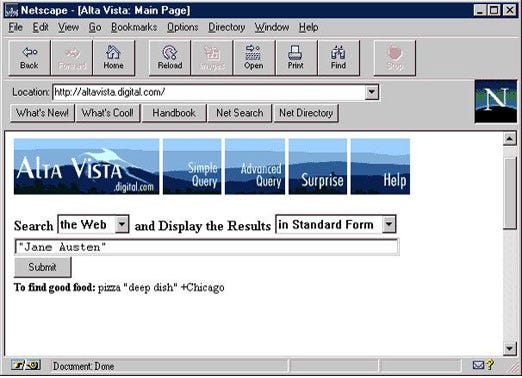
Google was founded in 1998 because Larry Page and Sergey Brin looked at the slop of early search and decided to clean it up. AltaVista was slop. Lycos was slop. Yahoo was a hand-curated directory because the algorithmic alternatives were worse than human work. The default attitude was the web is a mess and search will never be good enough. Page and Brin did not argue with the observation. They wrote a paper called The Anatomy of a Large-Scale Hypertextual Web Search Engine. The word anatomy gives the game away. They were dissecting the slop.
Twenty-seven years and two trillion dollars later, that one decision is the entire business model of the modern internet.
*
There is a particular thing happening right now, in May of 2026, that the slop watchers are also missing.
Google announced at I/O this year that search is changing. Not getting better. Changing. The interface most users will see, going forward, is not a list of ten blue links. It is a direct answer, synthesized by a model that has read the visible internet, written for the specific user, in response to the specific question.
This is not a search engine. It is a compiler.
What the compiler needs, in order to work, is not a beautifully designed website with three sliders and a hero image and a custom font. What the compiler needs is the data underneath the website. What you do, how you do it, what you think, what you offer, what you charge, where you are, what your hours are, who your customers love.
A great local plumber who never had the money for a website, who shows up on time, does honest work, and has been quietly satisfying his customers for twenty years, is about to be findable in a way he has not been in twenty years. The compiler reads the reviews, the receipts, the comments on the local subreddit, the mentions in the neighborhood newsletter, and presents him to the asker as the right answer to plumber near me. The asker is not scrolling a SERP. The asker is reading a paragraph that names him.
The same is true of the small restaurant that could not afford SEO. The same is true of the contractor whose website is one page from 2014 that says HOME ABOUT CONTACT. The same is true of the freelance writer whose site is a Squarespace template. The compiler does not care about the template. The compiler cares about the work.
This is bad news for some people. It is bad news for the SEO industry. It is bad news for website designers who built their practice on the assumption that the website was the storefront. It is bad news for the marketing-agency model that has been billing $50,000 a year for keyword optimization since 2009. It is bad news for the digital yellow pages.
It is spectacular news for every underdog who has been quietly doing the work, with no resources to play the SEO game, for the last fifteen years.
That is potential. That is the slop becoming product.
*
There is one piece of this people have not figured out yet. I am going to name it, because it is the part I am watching most closely.
Ads.
How does advertising work in a world where the search is not a list of links but a direct answer? Nobody knows. Google does not know. The smartest people at Google are, as of this writing, openly experimenting in public. The pattern of paid ad at the top, organic results below does not map onto one paragraph generated for the asker. You cannot have ten ads at the top of a paragraph.
This is slop. It is also the largest commercial opportunity in twenty years.
Whoever figures out the answer is the next Google. Maybe Google is the next Google. Maybe it is a kid in a dorm room. Maybe it is the third employee at a stealth-mode startup nobody has heard of yet. The thing I am sure of is that the answer exists, the market is waiting for it, and the people who are dismissing the current state of the technology as slop are not even looking at the gap.
I am looking at the gap.
*
There is a name in the framework I have been writing about for what is happening when somebody dismisses AI by pointing at slop.
It is the Yesterday Fallacy.
It goes like this. I tried it eight months ago. The output was slop. Therefore the output is slop now. Therefore the output will be slop forever.
The first part of that sentence is true. The output eight months ago was slop, in a specific way, with specific failures.
Every step after that is wrong.
What changed in the eight months is not nothing. Eight months in 2026 is two full doublings of capability. The slop you remember is two generations behind the slop you would encounter if you opened the same chat window today. The hand with seven fingers has been replaced by a hand with five. The crashing snake game has been replaced by a fully playable 3D snake game with shaders and a leaderboard. The hallucinated paper has been replaced by a system that, in most cases, flags when it is not sure.
Calling it slop today, while leaning on what it was eight months ago, is the most predictable fallacy in tech writing.
It is also the surest signal that the writer has stopped paying attention.
*
I want to close with a small, mostly cheerful idea.
If you are someone who has been calling AI slop, this essay is not a scolding. It is an invitation.
The slop is real. And the slop is the gap. The gap is where the next decade of business gets built. The companies that will define the next era are being formed, right now, by people who looked at the slop and saw, instead, a list of features waiting to be shipped. The advantage of being early to this is not that the technology is already good. The advantage is that the technology is not yet good, and the gap between what it does and what it could do is the precise size and shape of the company you have not yet started.
You can keep saying it is slop. You will be right, for now. You will also be right in the same way the person who said the internet is for nerds in 1995 was right.
Stop reading the slop as a verdict.
Start reading it as the map.