
Lost Work: AI as archaeologist of your own output

The work in front of you and the work behind you. The first is louder. The second is the one that, on the right week, finds you a job.
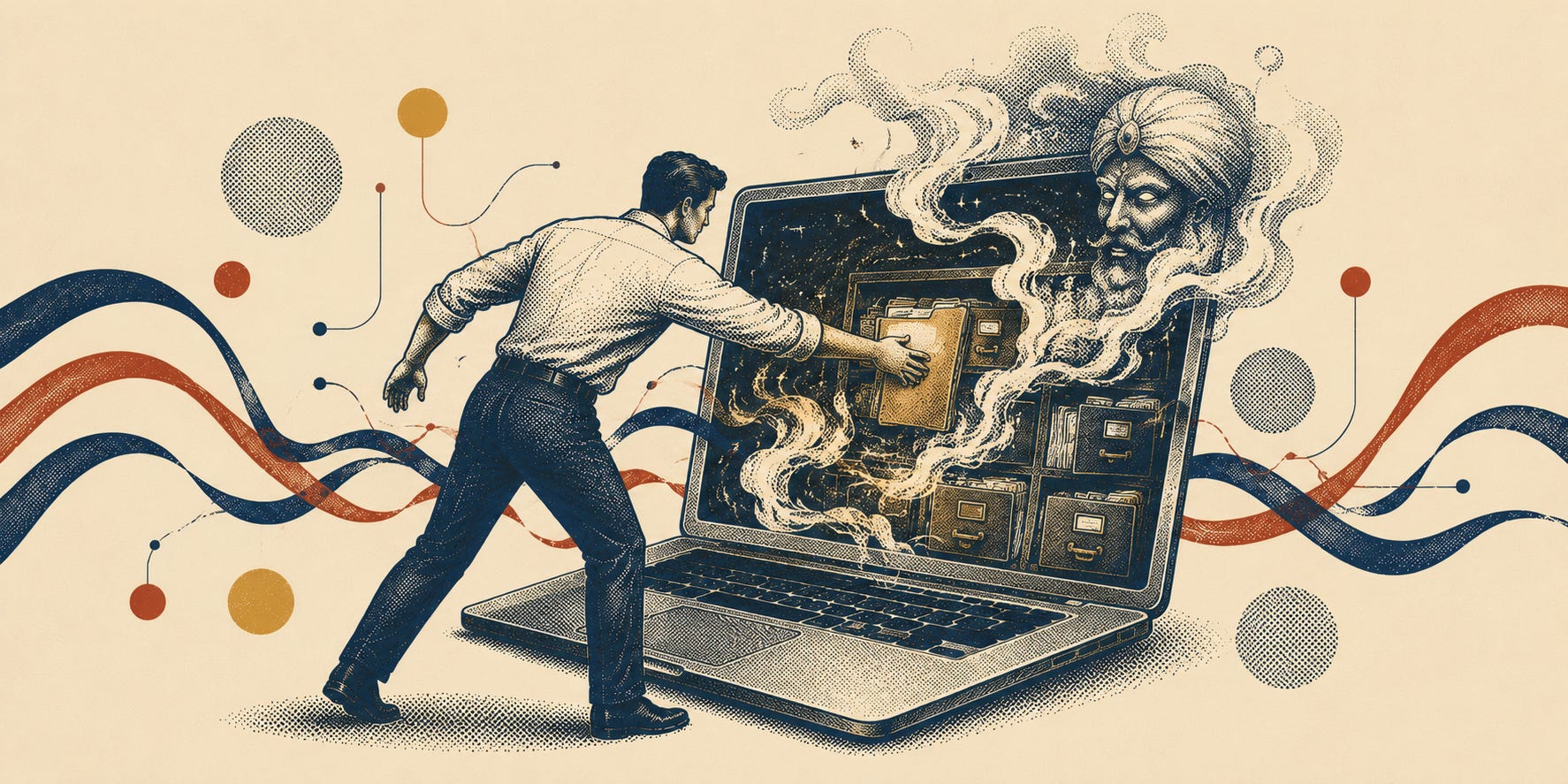
In October 2024 I started a Teams channel at the agency where I work. I called it AI Edges. The plan was modest. I would post things I was reading and watching about AI, with a sentence or two of framing for the team. A weekly cadence, more or less. A way to keep one professional eye open while the world rearranged itself.
I forgot about it as a thing. I kept posting. The posts kept happening. Tuesday, Wednesday, sometimes Friday. A new model release. A demo I had been chewing on. A custom GPT I had built for the team and wanted them to try. A primer I had written for a new hire. The channel filled up the way a notebook fills up when you carry it around for two years and never go back to read it.
Last week I asked a model to read the channel for me.
The model came back with a number I would not have produced from memory under any conditions. One hundred and sixty-eight posts. Nineteen consecutive months. An average of 8.8 posts a month. It gave me a list of every model release I had covered, every framework I had written, every custom GPT I had built for the team. Ten of them. Four primer documents. Sixteen articles I had curated. Forty-seven original takes. A reference, in our agency CEO’s all-hands talk last quarter, to the channel by name.
I had done all of it. I could not have written that paragraph from memory. The trove was mine, and I could not see it.
The dominant story of what AI is for, two and a half years in, is that it does the work in front of you. The email you have to send. The deck you have to build. The spreadsheet you have to wrangle. The same job, with less friction. That story is not wrong. It is also not the only story.
There is another thing it does, less talked about, and on certain days more valuable.
It reads what you have already made.
Most professionals are sitting on years of their own output that they have written and cannot read. Slack messages, Teams posts, email threads, project briefs, voice memos, photos of whiteboards, half-finished decks, late-night texts to a co-founder, the comments on a Google Doc nobody opened twice. Each fragment is small. The volume is not. A person who has worked for a decade has produced, conservatively, a small library of their own thinking, scattered across a dozen platforms, in formats that nobody, including the person who wrote them, will ever go back and read at scale.
The economics of going back used to be terrible. A human being asked to re-read their own three years of Teams posts would, generously, get through forty before deciding the rest of their afternoon could be spent on anything else. The data was there. The reading was the bottleneck. The pattern, the through-line, the case you could make about yourself, locked behind the cost of going back to look.
That cost has gone to roughly zero.
What changes when you can see your own archive?
The obvious answer is the practical one. Resumes. Promotion cases. Articles. Talks. The bio paragraph for the conference you got invited to. The cover letter you do not feel like writing. The brand-side recruiter conversation where you have to explain, in five sentences, what you have actually been doing for the last two years. All of these get easier when the data is legible to its own author.
But the resumes are pointing at something deeper.
The scarce commodity for most professionals is not output. It is evidence of pattern. The hiring manager, the editor, the audience, the new client, the partner across the table, none of them are buying what you did this week. They are buying the inference that what you did this week is what you have been doing for years, and what you will be doing for years more. Pattern is the asset. Pattern is what gets you the job, the byline, the seat.
Pattern is exactly the thing humans are bad at extracting from their own histories. The data is too granular. The volume is too high. The self-narrator is too unreliable. We forget what we have done. We collapse three years into the highlight reel we happen to remember. We pitch ourselves on the work we are most embarrassed about and undersell the work that, on the page, makes a real case.
The model is not a better narrator than I am. It is, however, willing to read the whole archive without skipping. It will count the months. It will surface the ten things I built and the four things I wrote and the one sentence the CEO said about the channel at all-hands. It will not flatter me, and it will not protect me, and it will not edit out the boring posts. It will produce, in the end, something I would have produced if I had been willing to spend a Saturday going through nineteen months of my own posts. Which I was not, ever, going to do.
The framing I keep coming back to is the work in front of you and the work behind you.
The work in front of you is what most of the AI conversation is about. Help me draft this email. Help me build this deck. Help me debug this code. The friction story.
The work behind you is the other thing. Help me see what I have already made. Help me see the pattern. Help me write the case for the thing I have been doing for two and a half years and would otherwise lose to my own forgetting.
Both are real. The first is louder.
The second is the one that, on the right week, finds you a job.
The data was already there. The lossy part was you. Now it isn’t.